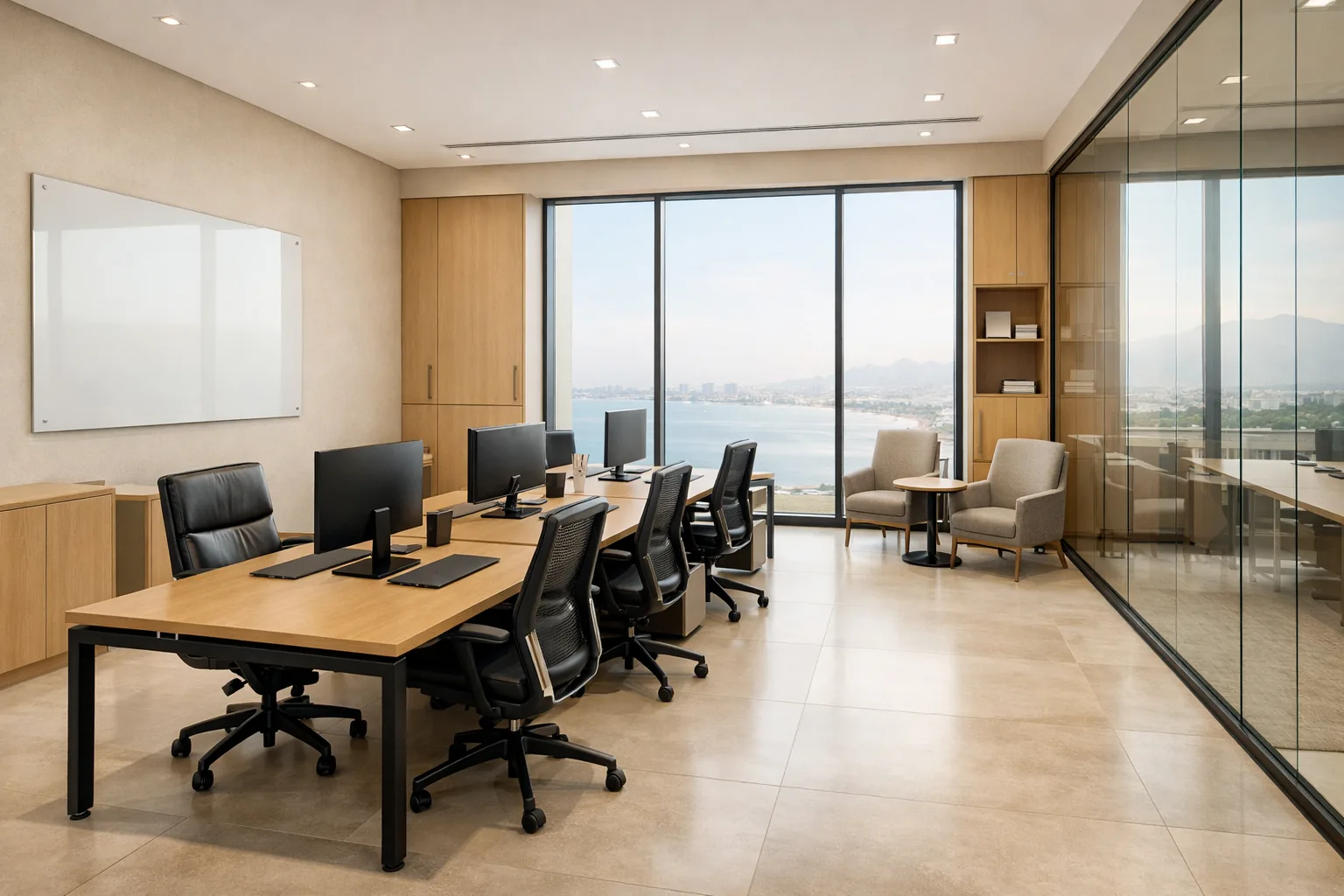
The practical difference between mainland and free zone is not prestige or ownership — those arguments are largely historic. It is what the authority requires your office to be, and how far that office stretches. A mainland licence wants dedicated, registered floor area and scales visas with square metres. A free zone sells an address inside a package and caps visas at the package ceiling.
- Mainland: physical, dedicated space with a registered tenancy; flexi desks and virtual offices are generally not accepted.
- Visa maths on the mainland: roughly one visa per 9–10 m² of registered space.
- Free zone: flexi desk usually accepted; visa ceiling set by package, commonly 1 to 4.
- Ejari: mandatory for Dubai mainland, not used inside free zones, and not the system used in Ras Al Khaimah at all.
- Tax: free zone 0% applies only to qualifying income under the QFZP rules — and the published thresholds are reported inconsistently.
The question is what the office has to prove
Both routes issue a valid UAE trade licence. What separates them is the evidentiary weight each places on the address. On the mainland, the office is the instrument through which the authority controls headcount — it must be a real, dedicated, registered space, and its floor area is a number in a file. In a free zone, the address is part of a product, and the zone itself vouches for it.
That difference explains almost every downstream consequence. It is why mainland setups take longer, why free zone packages quote a visa number on the brochure, and why a bank's compliance team treats the two addresses differently when it reviews an account application.
A mainland office is evidence. A free zone address is a product. Both are legitimate; they are not interchangeable.
Start the decision there rather than at the price. If you will need six employees on the ground within two years, the office question is already settled and the only open item is where you lease.
What a mainland licence demands of the office
A mainland company needs physical, dedicated office space with a registered tenancy contract, and the number of residence visas it may sponsor is derived from that floor area. The planning figure used across the sector is roughly one employee visa per 9 to 10 square metres, commonly expressed as 80 to 100 sq ft per visa.
In Dubai, registration of that tenancy happens through Ejari, the Dubai Land Department system. The official fee structure is AED 100 plus AED 10 knowledge, AED 10 innovation and AED 55 service partner, plus VAT. It is not optional: the registered contract underpins licence renewal, visa applications and bank compliance alike.
Two practical limits follow. First, flexi desks and virtual offices are generally not accepted for a mainland licence where staff visas are involved — the requirement is a partitioned, dedicated space, not shared seating. Second, the quota is reassessed when you renew or relocate; an office that supported four people does not silently stretch to seven.
The full arithmetic, including what each step costs, is set out in our guide to office space per visa in Dubai.
What a free zone asks instead
A free zone bundles the address into the licence package, and the visa allowance comes from the package tier rather than from measured floor area. A flexi desk — a shared workstation with the zone holding the tenancy record — is normally sufficient, which is why free zone setups complete faster.
The ceilings are modest and vary by zone. Published allowances commonly run from one visa on an entry tier to around four on an upper coworking tier; some zones place a flexi desk at up to three. RAKEZ, for example, publishes its four Compass coworking packages with eligibility for one, up to two and up to four residence visas — figures we set out, together with what providers actually charge, in the RAKEZ flexi desk cost guide.
Above that ceiling the logic changes. Once a free zone company takes dedicated office space, the visa count typically returns to a floor-area ratio in the same region as the mainland figure — around one visa per nine square metres is the ratio reported for at least one major zone.
| Requirement | Mainland | Free zone |
|---|---|---|
| Address type accepted | Dedicated, partitioned office | Flexi desk, serviced or dedicated office |
| Tenancy registration | Ejari in Dubai; municipal registration in other emirates | Held internally by the zone |
| Visa allowance | Scales with floor area (~9–10 m² per visa) | Set by package tier, then by area above it |
| Typical speed to licence | Longer — lease first | Faster — address included |
Visa ratios and package ceilings are the planning figures reported across UAE corporate service providers and free zone package pages in October 2026. They vary by authority and activity; confirm with the specific zone before committing.
Where the published guidance disagrees
Two figures in this field are quoted confidently and inconsistently, and you should know which ones before you plan around them.
The first is the mainland minimum office size. One widely repeated figure puts the practical floor at about 200 sq ft, roughly 20 m², with a 500 sq ft office described as supporting five to six visas. Another body of guidance states a typical minimum of around 50 m². Those are not reconcilable, and the difference is large enough to change a lease decision. The variance is probably real — minimums differ by emirate, activity and premises type — which is precisely why it should be confirmed with the relevant economic department rather than taken from a comparison article.
The second is the free zone de minimis threshold for corporate tax, covered in the next section.
Our position on both: use the ratio for planning, confirm the minimum before signing. A ratio that is wrong by a square metre costs nothing at the planning stage; a minimum that is wrong by thirty square metres costs a year of rent.
The tax question that can reverse the answer
A free zone company does not automatically pay 0% corporate tax. It pays 0% on qualifying income, and only while it satisfies the conditions for being a Qualifying Free Zone Person. Failing any condition moves the company to the standard 9% rate.
What counts as qualifying income depends on the activity rather than simply on where the customer sits. Manufacturing, processing, logistics and distribution from a designated zone are commonly described as able to reach mainland customers at 0%, while ordinary consultancy, marketing and software services supplied to mainland clients generally are not.
The de minimis allowance for non-qualifying revenue is reported two different ways in current guidance: as 5% of annual revenue, and as the lower of 5% of revenue or AED 5 million. We are not going to pick one. The correct source is the Cabinet Decision text or a tax adviser, and the practical point for this guide is narrower: an address with no substance behind it is a tax exposure, not just a cheap licence. Published commentary is explicit that a flexi desk with no employees, used as a conduit for invoices, is not what the regime contemplates.
This is the point at which the office decision stops being about rent. If your model depends on free zone treatment, the address needs enough reality behind it to survive a question about substance.
A decision sequence that holds up
Answer these four in order and the address usually picks itself.
- How many residence visas in eighteen months? Under three and a free zone package is plausible. Above four and you are buying floor area either way.
- Who are your customers? Predominantly mainland UAE clients in a service activity is the pattern most likely to pull you out of 0% treatment and towards a mainland structure.
- What does the bank need to see? If a corporate account at a major bank is critical early, a workstation someone can visit is worth more than a line in a brochure. The detail is in our guide to office requirements for a UAE business bank account.
- What substance will exist? Staff, operations, equipment. If the honest answer is none, free zone tax treatment is a question you have not answered yet.
Note what is absent from that list: ownership percentage. Foreign ownership arguments dominated this comparison for years and have largely been overtaken by reform. Deciding on that basis in 2026 means optimising for a constraint that may no longer bind your activity.
How this plays out in Ras Al Khaimah
Ras Al Khaimah offers both routes, and the office economics are what make it worth comparing against Dubai. Asking rents for standard offices in RAK sit far below Dubai mid-tier levels, which changes the arithmetic of the one decision that is otherwise purely a cost decision: when to stop renting a package and start renting space.
One correction worth carrying away: Ejari is a Dubai system and does not exist in Ras Al Khaimah. A tenancy outside a free zone here is registered with RAK Municipality instead, under a different process and a different fee basis. We set that out in the guide to tenancy registration in Ras Al Khaimah, and the cost comparison itself in Dubai versus Ras Al Khaimah office costs.
The summary we give clients is unglamorous. Count the visas, name the customers, be honest about substance, then choose the cheapest address that survives all three. In a large number of cases that address is in Ras Al Khaimah — but it is a conclusion, not a starting assumption.
Frequently asked questions
Can I get a mainland licence with a flexi desk?
Generally not where employee visas are involved. Mainland licensing expects dedicated, partitioned office space with a registered tenancy; shared seating and virtual addresses are usually rejected for that purpose. Some activity-specific exceptions exist, so confirm with the relevant economic department.
How many visas does a mainland office allow?
The planning ratio is roughly one employee visa per 9 to 10 square metres of registered office space, commonly cited as 80 to 100 sq ft per visa. A 45 m² office therefore supports around five visas. The ratio varies slightly by authority and activity.
Do free zone companies need Ejari?
No. Ejari is the Dubai Land Department tenancy registration system. Free zones hold the tenancy record internally, and other emirates use their own registration — in Ras Al Khaimah it is the Municipality rather than Ejari.
Is a free zone company always taxed at 0%?
No. The 0% rate applies to qualifying income of a Qualifying Free Zone Person. Income outside the qualifying activities, or failure to meet the conditions, is taxed at the standard 9% rate. Published guidance on the de minimis threshold for non-qualifying revenue is inconsistent, so check the Cabinet Decision text or take advice.
Can a free zone company sell to mainland customers?
Commercially this is a licensing question and tax-wise a separate one. On the tax side, whether mainland income keeps 0% treatment depends on the activity — manufacturing, processing, logistics and designated zone distribution are commonly described as able to, while ordinary consultancy, marketing and software services generally are not.
Which route is faster to a licence?
Free zone, usually. The address comes inside the package, so there is no lease to find, negotiate and register before the file can move. A mainland application starts with premises.
Does the mainland have a minimum office size?
Published figures conflict. One widely repeated minimum is around 200 sq ft, roughly 20 m²; other guidance cites around 50 m² as typical. Minimums vary by emirate, activity and premises type, so confirm before you lease rather than planning from a comparison article.
Does ownership still favour free zones?
Much less than it once did. Foreign ownership was the historic argument for free zones and has been substantially overtaken by reform, which is why we rank visas, customers, banking and substance ahead of it in the decision sequence.
Work out which route your visa count allows
Tell us how many visas you need and what you sell. We will set out the mainland and free zone options in Ras Al Khaimah side by side, with the floor area each one actually requires.
Ask on WhatsApp